
3-Ring Circus Summary: “Straight to Jail! How Adsorption Enhances Agarose Gel Cleaning”
Speakers: Teresa Duncan, National Gallery of Art, and Amy Hughes, Library of Congress
Co-Authors: Michelle Sullivan, The J.Paul Getty Museum, Kathryn Morales, The National Gallery of Art, Edwin Chan, National Institute of Standards and Technology, and Barbara Berrie, Independent Researcher
Summary by Liz Peirce, Library of Congress
In this talk, Duncan and Hughes presented their research on the modification of agarose gel based cleaning systems for removing water-soluble stains from works of paper. It is an expansion on their article that was published in Gels volume 11, which can be accessed here: The Role of Adsorption in Agarose Gel Cleaning of Artworks on Paper
Duncan focused on presenting how agarose gels work, emphasizing the difference between adsorption and capillary movement. In adsorption, the gel matrix behaves more as a sponge or trap, with water migrating back and forth between the gel and the paper artwork, depositing the soluble materials within the gel. Duncan tested this hypothesis by comparing the adsorption of crystal violet dye with agarose, microcellulose, and silica gel, finding that agarose is almost as effective as microcellulose and silica gel. After positive results, agarose was mixed to different concentrations both alone and with the silica gel as an additive. These samples were placed on a piece of degraded paper to see how much of the water soluble degradation products could be removed and to see if there were any tidelines.
Hughes spoke about practical applications and working properties of the gels, stating that while the addition of silica gel did make the gel matrix cloudy, more rigid, and more brittle, it had very similar working properties to a pure agarose gel. She also mentioned that different mixtures delivered water in different ways, specifically that added microcellulose created a more diffuse edge. She hopes that understanding these different properties will help conservators to better customize their gel compositions for each specific application. She then presented a case study on a water damaged print with a severe tideline. Using a 3% agarose gel bulked with 1% microcellulose, Hughes effectively performed a typical gel wash of the print. The print had been scanned with XRF prior to dry cleaning, after dry cleaning, and after washing to determine that the compounds being removed were only those from the stain.
Hughes and Duncan concluded with hopes for next steps, including workshops at the National Gallery of Art and the Library of Congress as case studies before offering training more broadly. They both emphasized that the close collaboration between conservation, conservation science, and analytical science was essential to understanding that adsorption plays a significant role in how gels work, how to manipulate the efficacy of a gel, and to create solutions for practical applications.
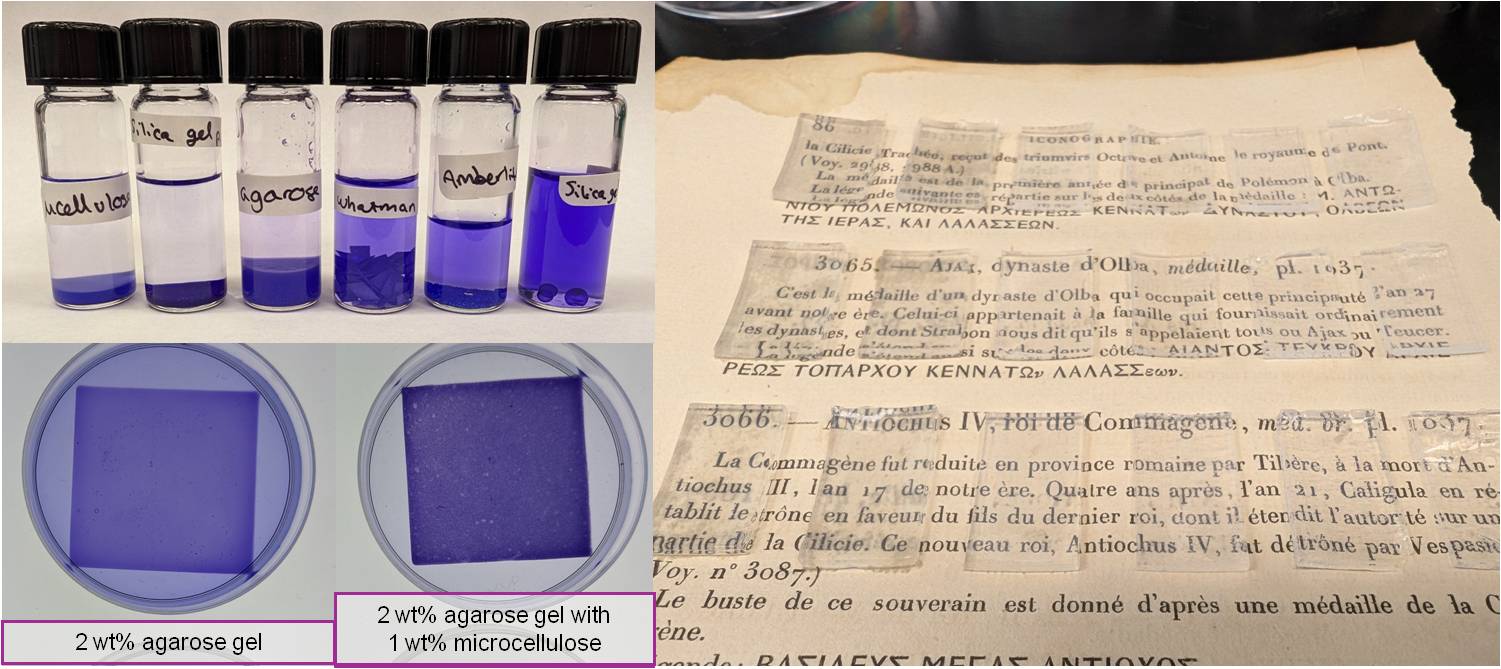
Image from Duncan and Hughes on their research into the modification of agarose gel-based cleaning systems for removing water-soluble stains from works of paper. (Image credit: Unknown)