
3-Ring Circus Summary: “Great Mongol Shahnama- Blue Pigments and Mixtures”
Speaker: Matthew Clarke, National Museum of Asian Art
Summary by Colleen Vick, intern at the National Museum of American History
Background:
In a research project spanning the past several years, Matthew Clarke has been using scientific imaging and analytical techniques to characterize blue pigments in a series of fourteen folios owned by the National Museum of Asian Art known as the Great Mongol Shahnama. The Shahnama is an epic poem written around 1000 C.E. by Ferdowsi detailing the history of Iran up to about the 7th C. This is only one copy of that tale, made in about the 1330’s while the Mongols were ruling Iran. During the Qajar period in 1830’s there was a refurbishment of the volume, signaled by a distinct Russian watermark on the new borders of the manuscript. From the original two volumes containing ~200 illustrations, there are only 57 known ones remaining today, with the collection of 14 at the National Museum of Asian Art being the largest collection known by any one museum.
Clarke has been particularly interested in the materials employed during the fabrication and subsequent ownership of the folios, leading to this research project. The primary goals of his research were to document the current condition of the materials, identify the materials and pigments used, and explore some restoration materials across the folios in the collection. Further, Clarke was interested in examining artistic intent when selecting different pigments throughout the illustrations.
Analytical Imaging and Techniques
Clarke carefully considered which techniques to employ during this pigment characterization, recognizing that some analytical techniques involve removing samples from the actual illustrations and destroying them to produce results. For this reason, he focused primarily on non-destructive techniques, such as using light and radiation. As an example, Clarke used critical visual examination to select four different blue pigments to perform analysis on.
The four main techniques Clarke employed were:
Hyperspectral imaging in visible spectrum (in collaboration with Dr. Erich Uffelman from Washington and Lee University)
Short-wave infrared (IR) imaging
X-ray fluorescence (XRF) mapping
Raman spectroscopy
During XRF mapping, Clarke focused on the presence of silicon (Si) and copper (Cu) for the blue pigments selected. He found that there were some sample areas which contained no copper and high levels of silicon; some with mid levels of each; some with high levels of copper and mid levels of silicon; and some with no copper or silicon present in significant amounts.
He overlaid this information with the visible reflectance and the short-wave infrared readings and determined that the presence of azurite was indicated in some blue pigments. Clarke then overlaid the Raman spectroscopy results with the mapping to indicate the presence of indigo as another blue pigment present. Raman spectroscopy results also indicated the presence of lazurite in natural ground lapis.
The results from these testing methods indicated the following blue pigments in the sample folio: very pure lapis lazuli, mixtures of lapis and azurite in various concentrations, and indigo.
Pigment contextualization across the folios
Clarke used the results from his testing to determine where certain pigments and pigment mixtures were present across the fourteen folios in the collection. He found that lapis lazuli was used in all fourteen. Indigo was used either in pure form or mixed with lapis in some of the folios (while it is present in all fourteen, in some cases it is mixed with other pigments to produce green). Azurite was used the least, and was only detected in five folios.
Next, Clarke was interested in evaluating where blue pigments were being used, and certain trends were discovered. Across the folios, there were four cases of blue pigments being used to color horses- in three of the four cases, indigo was mixed with a lead-based white to produce a light blue color (the other being azurite mixed with lead-based white). Clarke hypothesizes that blue was used to make the horses stand out visually and created a more aesthetic appearance than illustrating the horses as grey.
Another primary trend for blue pigment presence in the illustrations was the sky. Lapis lazuli was the most common pigment used in painting skies, though in one instance a mixture of azurite and lapis was used. One sky features white clouds, where indigo mixed with lead-based white was employed.
Some palettes were found to be more complex in their blue pigment characterization. The bier of Iksander is one of the most well known illustrations in the collection of Great Mongol Shahnama folios, depicting the death of Iksander with his mother draped across him and the philosopher Aristotle in the background weeping. This illustration has one of the largest swaths of blue pigment mixtures, including pure lapis lazuli, azurite, indigo, mixtures of all three pigments with lead-based white, and mixtures of azurite with indigo and azurite and lapis.
There is one other blue pigment that was detected during the research process in the folios, but was not original to the illustrations. This is Prussian blue, which was found on Russian paper that was added during the Qajar refurbishment period. There was no evidence of Prussian blue detected in the actual paintings during testing.
Conclusions
There was an extensive number of pigments and mixtures of pigments used across the fourteen folios in the National Museum of Asian Art’s collection. Clarke notes that it is difficult to know how the original artists chose which blue pigment to use for particular areas, but would be an area for additional study. He concludes that visual analysis of folios that are close to one another in the storyline aids in the material analysis being performed and what is shown in the illustrations.
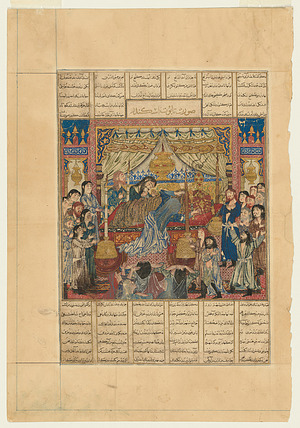
Folio from a Shahnama (Book of kings) by Firdawsi (died 1020); The bier of Iskandar, ca. 1330, Opaque
watercolor, ink, and gold on paper, National Museum of Asian Art, accession number F1938.3. Image Credit: National Museum of Asian Art